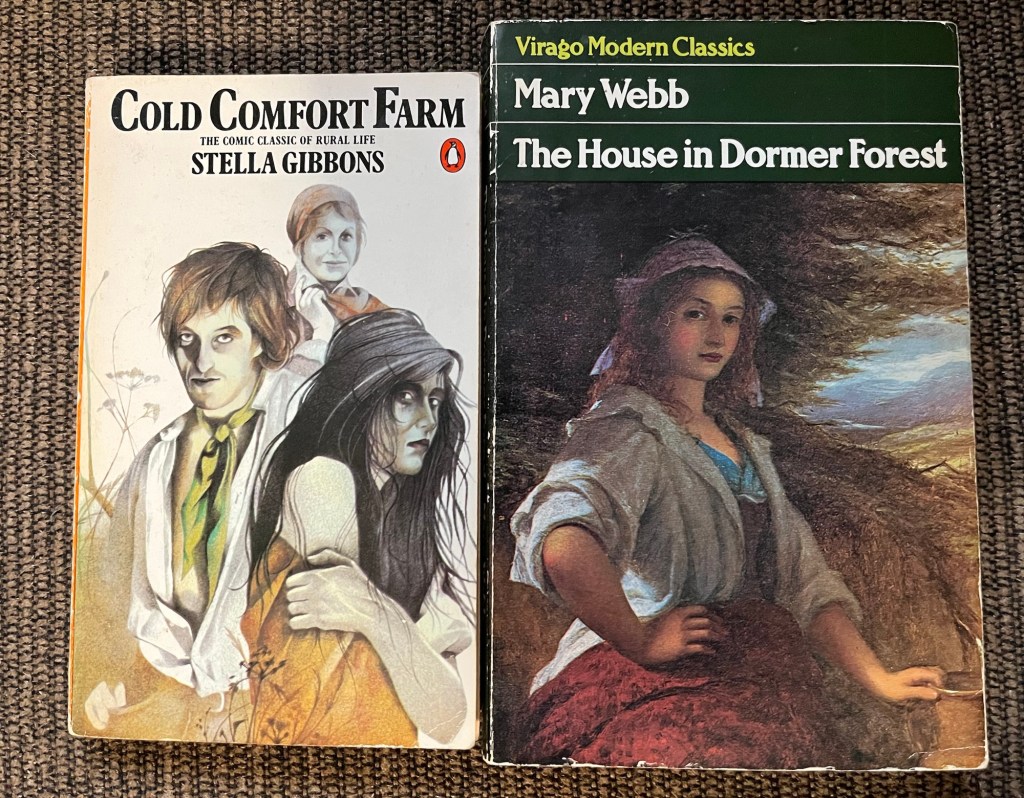
I’ve always loved Cold Comfort Farm. It’s one of those books I keep more than one copy of in case I lend it to someone and it doesn’t come back. But I’ve also always been aware that it was a parody. The spoof introduction and dedication to someone who is obviously a caricature of Thomas Hardy makes that clear.
I also corresponded online in the 90s with Stella Gibbons’ nephew. But until the late 1990s, I had no idea whose work Cold Comfort Farm was a parody of. And then it became clear that it was Mary Webb. I started reading her books and absolutely loved Precious Bane and The Golden Arrow (Gone to Earth is good, but not as good as the other two). I’m a huge fan of Thomas Hardy (especially The Woodlanders), so reading Mary Webb was a natural choice. She was also a huge nature mystic (check out Rebecca Beattie’s wonderful book Nature Mystics for more on that).
It was clear that Cold Comfort Farm was a parody of Mary Webb… and then I read The House in Dormer Forest by Mary Webb and the parallels with Cold Comfort Farm were massive. Apparently Stella Gibbons said that CCF was not a direct parody of THIDF, just of Webb’s work in general, but the parallels are too great to ignore. Perhaps Stella Gibbons unconsciously absorbed many of the details of THIDF and forgot that she had done so.
I thought I’d read Cold Comfort Farm and The House in Dormer Forest next to each other, to see the similarities and differences. Very interesting. The House in Dormer Forest is a lot funnier (intentionally funny, not accidentally) than I had remembered. Satisfying ending too.
The House in Dormer Forest also has an atheist in it (unusual for a book written in 1920), and a pantheist (Michael Hallowes), who’s also totally desirable in the way that only a man in a Mary Webb novel can be (also check out Kester Woodseaves from Precious Bane).
Spoiler alert! after this point, there are spoilers.
Let’s look at the similarities and differences between CCF and THIDF.
THIDF: There’s a cousin of the family (Catherine Velindre) who is a paying guest living in the house. She is cold, distant, and outwardly pious.
CCF: There’s a cousin of the family (Flora Poste) who comes to stay with the family. She offers to pay for her keep but the offer is declined due to some mysterious wrong done to her father, Robert Poste. Flora is highly practical & much nicer than Catherine.
THIDF: Enoch, the gardener, loves cows, Nature, and is highly protective of Marigold the kitchen maid, whom he loves.
CCF: Adam Lambsbreath, general dogsbody, has four cows and is highly protective of Elfine Starkadder.
THIDF: Marigold the kitchen maid gets pregnant by Peter Darke, son and heir.
CCF: Meriam the hired girl gets pregnant by Seth Starkadder, son and heir.
THIDF: Grandmother Darke appears to rule the roost but is in fact the puppet of her daughter.
CCF: Grandmother “saw something nasty in the attic” and is very controlling. Her daughter Judith is obsessed with Seth.
THIDF: Solomon Darke (the father of the house) is highly religious and holds prayers every day.
CCF: Amos Starkadder (the father of the house) is highly religious and preaches hellfire to the Quivering Brethren once a week.
THIDF: Amber is a nature mystic and a genuinely nice caring person, though rather plain-looking.
CCF: Elfine is a nature mystic who spends all day wandering the hills and composing poetry.
The families in both books are dark and brooding and full of barely-suppressed violence.
CCF: The house lurks in the shadow of Mockuncle Hill like a beast about to spring. It’s an untidy hodgepodge built by successive monarchs and then abandoned.
THIDF: The house lurks in a dell in the forest. It’s an untidy hodgepodge built during successive eras and then abandoned.
The main difference between the two books is that the cause of the changes in CCF is Flora Poste, who actively seeks to change the Starkadder family; whereas in THIDF, the catalyst for change is that Jasper is training to be a priest but stops believing in God and is sent home. His family is horrified, except for Amber, who genuinely cares about her brother and wants him to be happy.
The plots of the two novels develop in a similar way, with various characters escaping from the oppressive environment of the house through marriage to people outside the house.
Mary Webb accurately skewers the hypocrisy of conventional religiosity, and over-zealous piety.
Stella Gibbons accurately skewers hellfire preaching, but also alternative Bohemian types.
Both books are awesome, but it would be a pity if you let Cold Comfort Farm put you off reading The House in Dormer Forest, because it is really excellent, especially part two. Interestingly both authors won the Vie Femina Prix Heureuse. Mary Webb won it in 1926 with Precious Bane; Stella Gibbons won it in 1934 with Cold Comfort Farm.
The dénouement of THIDF, when it is revealed just what a nasty person Catherine Velindre is, is absolutely brilliant. I couldn’t put the book down at that point.
CCF is still a hilarious book and I am very fond of it and it’s sufficiently different from THIDF to be more than merely pastiche — but I also think THIDF is a work of genius.


 Dowsing for Divinity