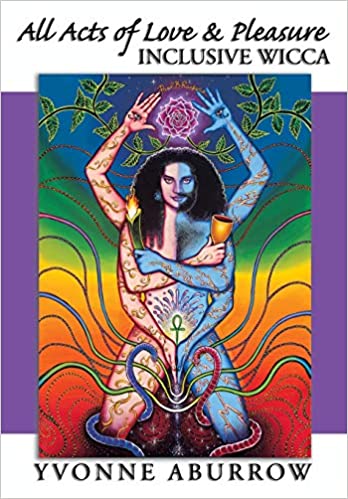
All acts of love and pleasure:
inclusive Wicca
A companion guide to inclusive Wicca, which includes people of all sexual orientations, ages, and disabilities by working with them creatively within initiatory Craft.
Avalonia, 2014.
Table of contents
- Introduction
- What is the Sacred?
- The Wiccan Circle
- Gender and Sexuality
- Polarity
- Spirituality and Sexuality
- Progressive Wicca
- Inclusive Wicca
- Queer Paganism
- Deities and Spirits
- The Nature of Truth
- Wicca and Science
- What is Magic?
- Initiation
- The Hidden Children of the Goddess
- Secrecy and Confidentiality
- Invocation
- Mythology for Wiccans
- Wiccan Rituals
- The Shamanic Ordeal in Wicca
- Eco-Spirituality and Embodiment
- Running a Coven
- Wiccan Values
- Witchcraft and Activism
- Visualisations
- Introduction to Wicca Course
- Progressive Wicca, a Talk Given in 1988 by Tam Campbell
- Bibliography & Further Reading
Reviews
From Mat Auryn, bestselling author of Psychic Witch:
Yvonne Aburrow’s All Acts of Love and Pleasure: Inclusive Wicca is a greatly needed book for any group. Though the book is written for Wicca by a Gardnerian Wiccan, the book is important for any group of witches that work together. Written with covens and groups in mind, the book addresses many changes regarding diversity within the modern Craft. Aburrow asserts that Wicca should be inclusive regardless of gender, sexuality, and mobility.
She writes that “Different people have different experiences, expectations, and perspectives, and including and working with different ideas and experiences can only enrich our Craft, not detract from it.” Instead of ignoring or erasing the differences of others, the book aims to explore methods of working with these differences. As such she provides ideas, practices, meditations, and queer myths to create a more inclusive group dynamic or to adapt workings when needed.
The book makes use of heavy citation and is intelligently written. Tackling the history and origin of many Wiccan concepts and practices to shed light on the importance of inclusion vs. dogma and to challenge pre-conceived notions within Wicca. Not only are aspects of ritual modified and adapted for queer inclusion and differently abled bodies, but the book also touches upon other modern sexual liberation movements such as polyamory and BDSM. Also explored are ideas of consent, ethics, and inclusion – ideas that must be challenged and evolve if British Traditional Wicca (or any form of witchcraft) is to survive new generations. It’s not the 1950’s anymore. Diversity must be embraced, not excluded.
The title of the book takes its title from “…for behold, all acts of love and pleasure are my rituals,” as is stated by the Goddess in the Charge. As such, this book is written in the spirit of the Goddess, Mother of All and not some, surpassing all man-made trappings of rules placed within the Craft. The book is perfect for anyone who wants a non-binary perspective of Wicca, and anyone in a leadership role within Paganism.
Yvonne Aburrow’s book is an outstanding Wicca 201, intended for already-active, primarily initiatory covens, that examines Wiccan praxis and theology. This is the next step once you have established a solid Wiccan practice. Many aspects of Wicca are examined with an eye towards inclusivity; Aburrow covers LGBTQ, BDSM, polyamory, and asexuality; physical and mental disabilities; cultural appropriation; and trauma recovery in the context of ritual practice, relationship to divinity, and mythology. She also tackles, with dignity and respect, most of the issues that currently divide the Pagan community; science vs. magick, polytheism vs. humanism; sexuality and gender; and ecology and activism as spiritual practices. The author looks at some of the common Wiccan myths and makes suggestions for ways to incorporate deep ecology, from adapting the Wheel of the Year to appropriately reflect your climate and geography to reducing your carbon footprint.
The aspects of the book I most enjoy appear to be the ones that are getting the least attention. Aburrow has an outstanding section on invocation. She asks us to consider the specifics of our spirituality at length; What is the nature of truth? Is it possible to hold contradictory truths at the same time? Is there such a thing as absolute truth? Yvonne examines the nature of magick and Wiccan theology in a way that encourages the reader to come to her own conclusions. She considers the nature of the left- and right-hand paths in a way I never had (left-hand path work is about building the ego towards Ascension; right-hand path work is about breaking it down to achieve union with the Godhead) and emphasizes that both are valid. Yvonne covers the ordeal path and the mechanics of magick. She even offers a basic outline for a Wicca 101 course curriculum in case you want to teach one.
 Dowsing for Divinity