There’s currently a trend of criticizing Gerald Gardner for making stuff up, such as the festivals etc. Gardner never claimed that the Wheel of the Year was ancient, and he did not label the festivals with Celtic names (that happened much later, after his death). Each of the festivals in the Wheel of the Year was celebrated somewhere in ancient times — they just weren’t all celebrated by the same culture; and he knew that he was joining the four “Celtic” festivals (Candlemas, May Eve, Lammas, Hallowstide) with Old English ones (the solstices and equinoxes).
People who are saying that Gardner made stuff up, or made a lot of mistakes, seem to have forgotten that there was no internet in the early 1950s. If you wanted to find things out, you had to go to the library (where a lot of the historical information was out-of-date or wrong), or amass your own collection of books (at great expense because occult books were scarce).
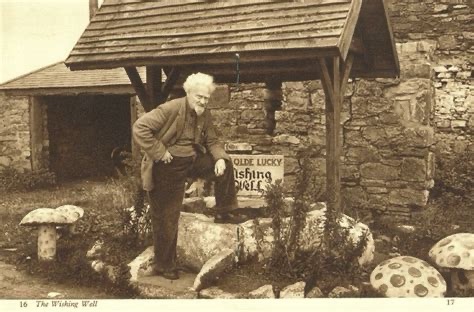
And there were no computers at the library to help you find the book you wanted. Instead you had to search in a cabinet full of index cards, like this:

A lot of the errors in Gardner’s work were based on errors in his sources. Granted that he also vastly overestimated the number of witches in the medieval period, but so did many other writers (Matilda Josslyn Gage, Margaret Murray etc) whom he used as sources.
Gerald Gardner didn’t go to school as his parents sent him away on cruises every winter because of his asthma (there were no asthma drugs or inhalers back then). So his education was patchy.
The consensus is that he also enjoyed a good windup — he wrote “witches are consummate leg-pullers”.
It seems that the idea that witches live in the last house in the village was a joke based on the fact that some members of the New Forest Coven lived in a house on the edge of the village (according to Philip Heselton’s book, In Search of the New Forest Coven).
But the idea (discussed in The Meaning of Witchcraft) of many covens throughout medieval England seems to have been drawn from the work of Margaret Murray, or perhaps extrapolated from her work.
There are plenty of people nowadays spouting ill-informed opinions on the origins of Wicca and the Pagan revival with far less excuse—because they do have access to the internet—than Gerald Gardner, who only had access to a bunch of late 19th and early 20th century scholarship, some of which was wrong.
If you want to know how and why the Pagan revival and Wicca got started, I highly recommend reading Triumph of the Moon: a history of modern Pagan witchcraft and Stations of the Sun: The ritual year in Britain, both by Ronald Hutton.
For the history of Wicca and Paganism in the United States, I recommend Chas Clifton’s Her Hidden Children.
And if you’re interested in Gerald Gardner and Doreen Valiente, I recommend reading Philip Heselton’s books about them.
Edited to add:
Also check out this 1997 speech by Doreen Valiente where she explained what life was like in the 1950s / early 60s: no popular occult books or Tarot decks (one of her books has an explanation of how to use playing cards for divination because Tarot decks were so hard to obtain). And a prevailing attitude from the bourgeoisie and aristocracy that one wouldn’t want “the lower orders” to get hold of things like that.
I believe that Gerald Gardner genuinely believed what he was writing (with the probable exception of the “last house in the village” thing). He had read about witches in the medieval period in Margaret Murray’s books; when he was initiated by the New Forest coven, he genuinely believed them to be a coven with 19th century antecedents (they told him they remembered being a coven in the early nineteenth century, fending off the invasion of Napoleon).
Further thought…
Gardner seems to have been trying to upgrade Witchcraft 1929 with a patch from Crowley 6.6.6 and Murray 1.0 and those three are not compatible.
Luckily he called tech support in the form of Doreen Valiente and she uninstalled the Crowley patch. Later, the Murray patch was upgraded to the Ronald Hutton update which performed much better.


 Dowsing for Divinity
4 responses to “Gerald Gardner and history”
I don’t think the trend of criticising Gardner is exactly a ‘current’ one – implying that it’s somehow new or transitory. I’ve been initiated since the 1990s and the wishful thinking and sloppy scholarship in his books made my hackles rise even then. If only he had had the courage of his own convictions and owned Wicca as an imaginative reconstruction, instead of pretending it had some unbroken lineage to the distant past.
He and Ross Nichols are as guilty as each other of trying to stand on the shoulders of non-existent giants. They brought into being a new, reimagined way of relating to the world and this creativity is what we should celebrate, not their fake ‘scholarship’ with its pretend PhDs.
LikeLiked by 1 person
Hi Kim, yes the trend of criticizing Gardner comes in waves, and there’s currently another wave of criticism.
I don’t mind accurate criticism— but as someone mentioned in a comment about this on Facebook: Margaret Murray was the author of the entry on witchcraft in the Encyclopedia Britannica until 1960. Most of the academic establishment may have rejected her theory but (as Ronald Hutton himself says) this was not known to the general public.
Of course his theory was wrong and his historiography was distinctly lacking, but this post invites you to consider the reasons why that was the case.
I’m not defending the theory, I’m pointing out that there were very good reasons why he wrote what he did, and it’s very likely that he believed it.
LikeLike
I have no evidence of whether or not Gardner ever did it, but a certain type of person is wrong for helpful intent. Secondary school physics teachers, for example, are well known for teaching things that are incorrect according to current theories because those theories are much too complex and Newtonian physics is close enough in the context of starting to learn physics that it lets budding physicists get toward the more complex truths.
So, one could deliberately be incorrect about the truths of witchcraft to start people on the path to witchery without having to address truths that could be a barrier due to complexity or other factors.
Certain traditions, Zen for example, even embrace the idea of being wrong for the sake of the student challenging it, both because it weakens unthinking submission to perceived authority and because many people invest more in things they have discovered (especially if they are not widely known) than in things they are simply told.
So, rather than mistake or leg-pulling, Gardner could have intended some of what we see as inaccuracies to be a helpful framework that would fall away once someone reached the truths.
Absent a sudden discovery of a cache of papers or a widespread message from beyond, I suspect we will only ever be at the stage of inferring probabilities.
LikeLiked by 1 person
Ooh I love that idea, Dave
LikeLike