There’s been a bit of a trend lately for AI-generated “what would you look like as a Viking” pictures. I’m boycotting AI for various reasons (it’s soulless, I don’t like where it is headed, it’s currently unregulated, and AI “art” plagiarizes human art). So I thought I would search for a nonbinary Viking image created by a real artist and post that instead. I found a picture of a dead nonbinary Viking, which was featured in a really interesting article about a nonbinary Viking burial (obviously the Vikings didn’t necessarily have the same ideas about gender as we do, but this burial has both male and female accoutrements and the deceased person had Klinefelter syndrome).
The clothing, objects and fashion they were buried in heavily suggested that the individual was most likely a leader in the community. Furthermore, the non-binary identity of the individual’s gender was not only accepted, but upheld and reflected in the burial practices, as again, the leader was buried with both traditionally male and female burial objects.
— The presence of nonbinary Vikings in Viking societies — Fynley Calder-Rasmussen in GenZHer
The Guardian article about this burial also has a photo of their sword and a link to the original peer-reviewed article on the burial.
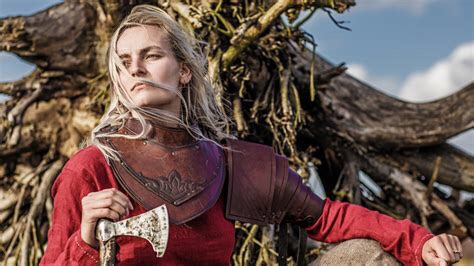
of the nonbinary Viking
Another article on Medium about the nonbinary/Klinefelter burial sets the scene for us with an evocative description of the times:
The year is 1150ce, and Finland is a brutal place to be. The normal dangers of sub-zero winters, wild bears, and wolves are set aside as war and faith bring change to the land. Finish tribes clash over power disputes as Sweden and Denmark prepare to invade with Catholic crusades. The powerful age of the Vikings is coming to an end.
Sonora Hills, The Story of a Thousand-Year-Old Non-binary Viking
An excellent article in Time magazine provides more context about gender in the later Viking period and cites other examples of burials that didn’t conform to gender stereotypes.
…archaeologists occasionally find people buried with objects and clothing that would usually be associated with the opposite sex. These include male skeletons wearing what appear to be dresses of the kind more conventionally buried with women, or with the oval brooches that hold the apron together at the breast, and similar combinations. For burials with female bodies, an equivalent is the presence of weapons in numbers sufficient to plausibly suggest a warrior identity for the dead. At Vivallen in Swedish Härjedalen, there was even a male-bodied person buried according to Sámi rituals, in a Sámi settlement, but wearing conventional Sámi man’s equipment over a Nordic woman’s linen dress, complete with jewellery to match—a crossing of both gender and cultural norms.
From Children of Ash and Elm: A History of the Vikings by Neil Price (2020)
Most of the articles on this topic conclude by saying that we need to rethink the idea that Vikings had a simple binary concept of gender.
We only have to look at the stories of Loki and indeed Oðinn and their adventures with gender to realize that ancient Norse people had more complicated ideas about gender than they’ve been given credit for.
Other ancient pagan cultures also had nuanced ideas about gender, so it’s not surprising that the Norse pagan culture would have had nuanced ideas as well.
Rigid gender binary ideas are mostly derived from Christianity, though even there, ways and means were provided to escape from them (most notably in monasteries and nunneries). Some ancient pagan cultures also had rigid gender binaries. But many of them had gender variations and ways for people to change gender roles.





 Dowsing for Divinity
One response to “Nonbinary Vikings”
A wondrous gathering of various sources.
LikeLiked by 1 person