I’ve just read an interesting article from Storm Faerywolf about reclaiming the word warlock.
I agree that before I encountered the contemporary Pagan movement, I assumed that a male witch was a warlock, and when I started hanging out with other Pagans, I was told that we don’t use it. And I don’t see why people can’t reclaim it, just like people have reclaimed the word “witch”.
However, as a nonbinary witch, I wouldn’t want the word witch to mean only “female witch”. Storm suggests that warlock should be a subcategory of witch. I guess you could be a nonbinary warlock too if you wanted.
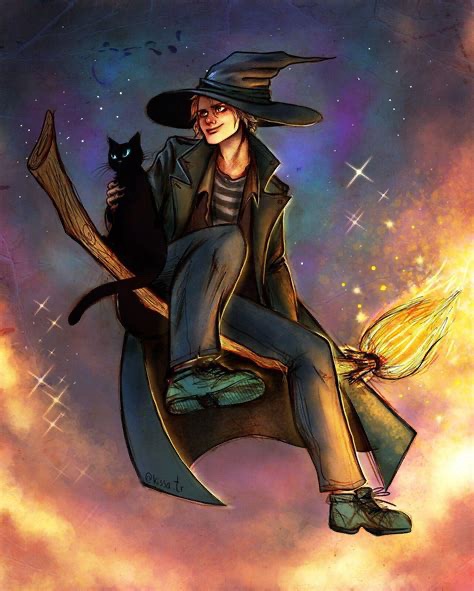
It’s a bit of a stretch, but could warlock have originally been a coven role like summoner and fetch? The Freemasons have a Tyler (derived from tailleur), a person who guards the door.
The standard etymology of warlock is not particularly flattering, and it seems to have been originally applied to the devil, giants, and cannibals — but then again it has also been suggested that the word witch is ultimately derived from a word meaning necromancer. And witchcraft is by no means restricted to necromancy.
Storm points out that a male witch was referred to as a warlock for hundreds of years and the original etymology is not the only meaning of a word.
Edited to add this article on the subject of warlock by Niklas Gander.

 Dowsing for Divinity
One response to “Reclaiming “warlock”?”
Definitely agree on the need to avoid fixed categories becoming a limitation on the possible. I think there might be something beyond avoiding restriction: taking active power from transgressing it.
Both Thor (when recovering Mjolnir from the giants) and Odin (when practising magic) immerse themselves in the traditionally feminine but the stories play out very differently: while some people have played Thor’s story for comedy, the usual portrayal is that Thor’s cunning is as great and admirable a trait in a man as his strength; whereas Odin’s learning and use of seið-magic has the echo of unmanliness that Faerywolf alludes to; this suggests that the power that Odin gained lay not in setting aside the appearance of his social role but in transgressing it.
The same idea of drawing power from deliberately breaking social mores appears in other traditions, from certain ancient tantric rituals to (less modern than I instinctively think it is) chaos magick.
So, whatever persons at various points in history and geography might have meant by warlock, perhaps it could be differentiated from witch as one who uses the active breaking of limitations as a method of spiritual/magical advancement rather than only the more passive disregarding of false boundaries to advancement.
LikeLiked by 1 person